Syrup Concentration Monitor 971-C
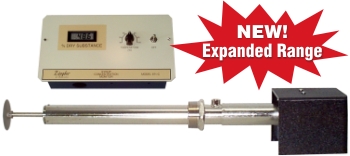 The Syrup Concentration Monitor Model 971-C is designed to measure syrup concentration up to 95%
in tanks or pipelines. The instrument operates under pressure or vacuum
and is unaffected by direction or velocity of syrup flow. The probe can be installed directly
in equipment at a favorable point to minimize measurement lag, improve control of
concentration and eliminate troublesome sample withdrawal problems.
The Syrup Concentration Monitor Model 971-C is designed to measure syrup concentration up to 95%
in tanks or pipelines. The instrument operates under pressure or vacuum
and is unaffected by direction or velocity of syrup flow. The probe can be installed directly
in equipment at a favorable point to minimize measurement lag, improve control of
concentration and eliminate troublesome sample withdrawal problems.
The Model 971-C uses the same measuring probe as our Model 970-C, which has long been
used to measure massecuite consistency in vacuum pans. A small shunt-type DC motor rotates the
971-C's larger 3" rotor at approximately 1500RPM. The instrument measures viscous drag
from changes in armature current, then amplifies and linearizes the current to actuate the
indicating meter and the transmitter output signal.
Temperature has quite an effect on most syrup properties and viscosity is no exception. In
the 45% to 95% range, it is about 0.25 Brix/oC. In factory processing operations,
temperatures are generally quite constant and infrequent manual adjustment by means of a
calibrated dial on the monitor is adequate. However, automatic compensation for wide
variations in temperature can be supplied in the form of a thermal element mounted in the
syrup near the viscosity probe and electrically connected to the 971-C monitor.
Viscosity is a syrup property rarely used industrially for determining
solids content, primarily because it is such a non-linear relationship. But the 971-C takes advantage
of a unique principle used in our Model 970-C -- the probe gives an output that
varies as the logarithm of viscosity over a range in excess of 100 to 1. The 971-C extracts a
second logarithmic function to produce the linear concentration scale.
Viscosity has several advantages over other methods of measuring syrup concentration.
To eliminate excessive errors, density methods require that material is thoroughly de-aerated before
measurement. This can create intolerable time lag in control circuits.
By contrast, the Model 971-C is hardly affected by the presence of entrained air bubbles
and the high peripheral velocity of its rotor discourages scale accumulation.
The 971-C is only sensitive to a relatively thin syrup film in contact with the disc and
is not affected by the direction or velocity of flow past it. In stagnant syrups, its
rotation provides considerable agitation to mix stratified streams as found in syrups
leaving evaporator bodies. Thus, it can be installed directly under an evaporator body and
provide good average readings even under very low flow conditions with minimum measurement
lag.
For more details, please download the appropriate installation manual:
971-C Installation Manual - 24V motor
(current model, serial #1027 and higher)
971-C Installation Manual - 130V motor (older model, serial #1026 and lower)

 The Syrup Concentration Monitor Model 971-C is designed to measure syrup concentration up to 95%
in tanks or pipelines. The instrument operates under pressure or vacuum
and is unaffected by direction or velocity of syrup flow. The probe can be installed directly
in equipment at a favorable point to minimize measurement lag, improve control of
concentration and eliminate troublesome sample withdrawal problems.
The Syrup Concentration Monitor Model 971-C is designed to measure syrup concentration up to 95%
in tanks or pipelines. The instrument operates under pressure or vacuum
and is unaffected by direction or velocity of syrup flow. The probe can be installed directly
in equipment at a favorable point to minimize measurement lag, improve control of
concentration and eliminate troublesome sample withdrawal problems.